Understanding Sound Level Meters Part 1
July 8, 2025

It is important to understand how sound energy is measured, to choose the right instrument to test sound pressure level.
Understanding basic sound level measurement concepts
Sound is a phenomenon caused by fluctuations in air pressure. Even at same amount of pressure fluctuations, we, humans do not feel they are the same at different frequencies. Hence, to evaluate the loudness as perceived by human ear, it is important to consider auditory sensations and its characteristics.
Frequency weightings:
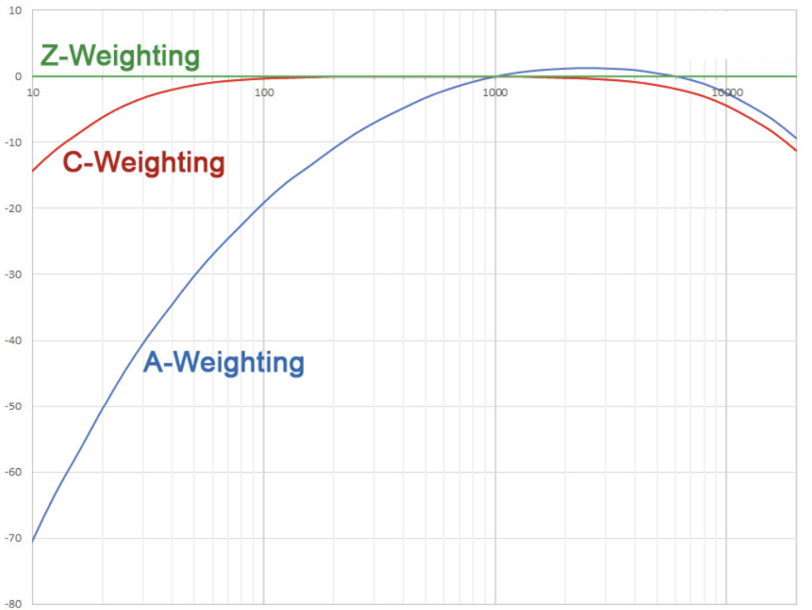
Our ears are most sensitive to frequencies between 500Hz and 6kHz and are less sensitive to frequencies above and below these. For a sound level meter to measure and report noise levels that represent what we hear, frequency weightings are used.
‘A’ frequency weighting – A Weighting is the most commonly used and covers the full frequency range of 20Hz all the way up to 20 kHz. It adjusts the readings to reflect the sensitivity of the human ear. At lower and higher frequencies, the human ear is not very sensitive whilst being more sensitive between 500 Hz and 6 kHz. This is the most commonly used weighting to understand effect of sound level on human ears.
‘C’ frequency weighting – At higher sound levels (volumes), our ears have a flatter response, and this C weighting is used to represent that, giving much more emphasis to low frequency sounds. This is commonly used for peak sound pressure level.
‘Z’ frequency weighting – ‘Linear’ weighting is similar to Z frequency weighting, which represents a flat frequency response(no filters) to the entire frequency measuring range. It is used where analysis of the sound source is required rather than the effect the sound has on humans, such as in testing the frequency response of produced loudspeakers in a manufacturing process.
Time averaging:
Time averaging is used to analyze signals with a need to reduce the impact of short term fluctuations. The idea is to compute an average of signal over a specified time period to get smoother representation of the signal.
Linear time average – This method averages the signal value over a fixed time window, treating all data in the window equally.
Exponential time average – This method averages the signal value over a fixed time window, giving more weight to recent data, to react faster to signal changes. This is much more common as sound level meters are generally required to measure near to real time changes in noise levels.
Time weighting:
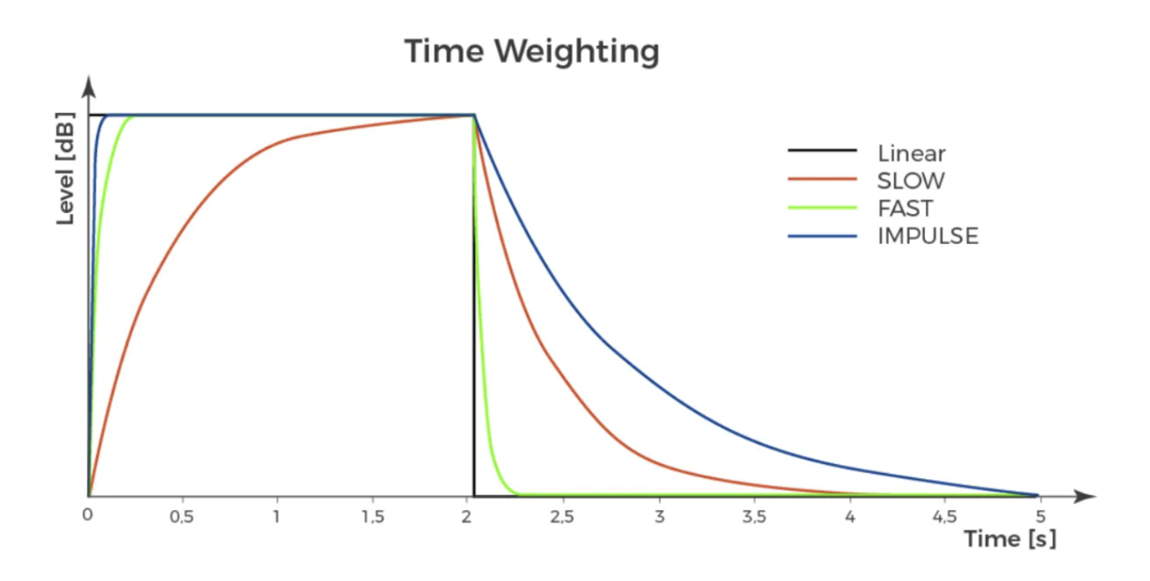
Time weighting refers to exponential time averaging method, where the instrument’s sensitivity to fluctuating sound level is adjusted as per the required response.
Slow(S) time weight – With a time constant of 1s, this is slow reacting, used for rapidly changing sound levels.
Fast(F) time weight – With a time constant of 125ms, this is fast reacting, used for sound levels, which do not change rapidly.
Impulse(I) time weight – Specifically designed for measuring sounds with sharp peaks (like gunshots, fireworks), intended for measuring short impulse sound signals. It reacts very quickly to sharp rising sound level signal, while decays slowly to level drops.
.png)


